Qibla is the direction Muslims turn to in prayer, and it ends at one place: the Kaaba, in the city of Makkah (Mecca). What is qibla, then? A line, not an object. The Arabic word قِبْلَة means "direction", and the line runs a different way depending on where you stand.
What is qibla in Islam?
In Islam, the qibla is a single shared aim: Muslims everywhere turn toward the Kaaba, inside al-Masjid al-Haram, the Grand Mosque of Makkah. Ibn 'Uthaymeen calls facing it "one of the conditions of prayer". Scholars agree on this rule for normal conditions.
You rarely have to work the line out alone. In most mosques, the niche called a mihrab already marks it. At home, the line comes as a number in degrees, so get the number for your own location. Then fix that line on a wall to save starting again at each prayer.
What does qibla mean?
Qibla means "direction" in Arabic. Behind it lies the sense "which is opposite". By extension, Arabic also uses qibla for something or somewhere people ought to seek.
You will see it spelled qibla, qiblah or kiblah, and the plural is qiblas. English speakers say KIB-luh. In standard Arabic, the word starts with a q sound made far back in the throat.
The word comes from the three-letter Arabic root q-b-l (ق ب ل). That root also gives qabl, "before", which the Quran uses 242 times, and qibal, "towards", found in verse 2:177. Words from this root occur 294 times in the Quran, in 13 forms. Only 7 of the 294 are the noun qiblah.
Change one vowel and you have a different word. قُبْلَة (qubla), with a u, means "kiss". Wiktionary lists them as two separate words.
Qibla meaning in Urdu and other languages
Many languages spoken by Muslims use a form of the Arabic word. Watch the last column, because three of these forms carry a second sense that has nothing to do with the Kaaba.
| Language | Written | In Latin letters | Second sense |
|---|---|---|---|
| Urdu | قِبْلَہ | qibla | A respectful way to address a father or a revered person |
| Hindi | क़िबला | qiblā | - |
| Bengali | কিবলা / কেবলা | kibla / kebla | - |
| Persian | قبله | qeble | - |
| Turkish | kıble | kıble | - |
| Malay and Indonesian | kiblat | kiblat | In Indonesian, direction in general |
| Swahili | kibla | kibla | - |
| Hijazi Arabic (western Saudi Arabia) | gibla | gibla | - |
| Maltese (old use) | qibla | qibla | "South", as in some Maghrebi Arabic dialects |
An Urdu speaker can tell the two senses apart from the rest of the sentence. One is the line you face in namaz (prayer), and the other is a word of respect for an elder.
Why do Muslims face the Kaaba when praying?
The Quran gives the order by name in Surah al-Baqarah 2:144, and verses 2:149 and 2:150 repeat it. The key lines of Quran 2:144 read, in Sahih International:
"So turn your face [i.e., yourself] toward al-Masjid al-Haram. And wherever you [believers] are, turn your faces [i.e., yourselves] toward it [in prayer]."
A convert told IslamQA that family members were asking the obvious next question: if you face a building, are you not worshipping it? The reply, answer 13932, gives Allah's command as the reason, then separates the place from the stones:
"our prayer facing the direction of the Ka'bah has nothing to do with the structure of the Ka'bah, rather it has to do with its location. If it were to be destroyed, we would still pray in that direction"
The same answer points to people on the upper floor and roof of the Grand Mosque. They face that spot with no Kaaba in front of them.
SeekersGuidance says it more directly. In an answer approved by Shaykh Faraz Rabbani, Ustadha Raidah Shah Idil writes: "although we are commanded to pray towards the Ka'bah, we do not worship it."
Where the word qiblah appears in the Quran
A first-time reader can find all 7 uses of the noun qiblah in 5 verses: 2:142 to 2:145 in Surah al-Baqarah, and 10:87, about Moses. The extracts use the Sahih International translation.
| Verse | Short extract | What is happening |
|---|---|---|
| 2:142 | "What has turned them away from their qiblah, which they used to face?" | People question the change of direction |
| 2:143 | "We did not make the qiblah which you used to face except that We might make evident who would follow the Messenger" | The reason given for the earlier direction |
| 2:144 | "turn you to a qiblah with which you will be pleased" | The turn toward al-Masjid al-Haram |
| 2:145 (3 uses) | "your qiblah", "their qiblah", "one another's qiblah" | Each community keeps its own direction |
| 10:87 | "make your houses [facing the] qiblah" | Moses (Musa) and his brother settle their people in Egypt; the Quranic Arabic Corpus glosses the word here as "places of worship" |
Verse 2:148 makes a related point without that noun: "For each [religious following] is a [prayer] direction toward which it faces".
The earlier qibla was Jerusalem, and Muslims turned to the Kaaba in the second year after the Hijrah, the move from Makkah to Madinah. The story of that turn has the details.
Which direction do Muslims pray?
Muslims pray toward the Kaaba, so no single compass word fits everyone. The answer is roughly west in Pakistan and Bangladesh, roughly north in Kenya and north of east in Nigeria.
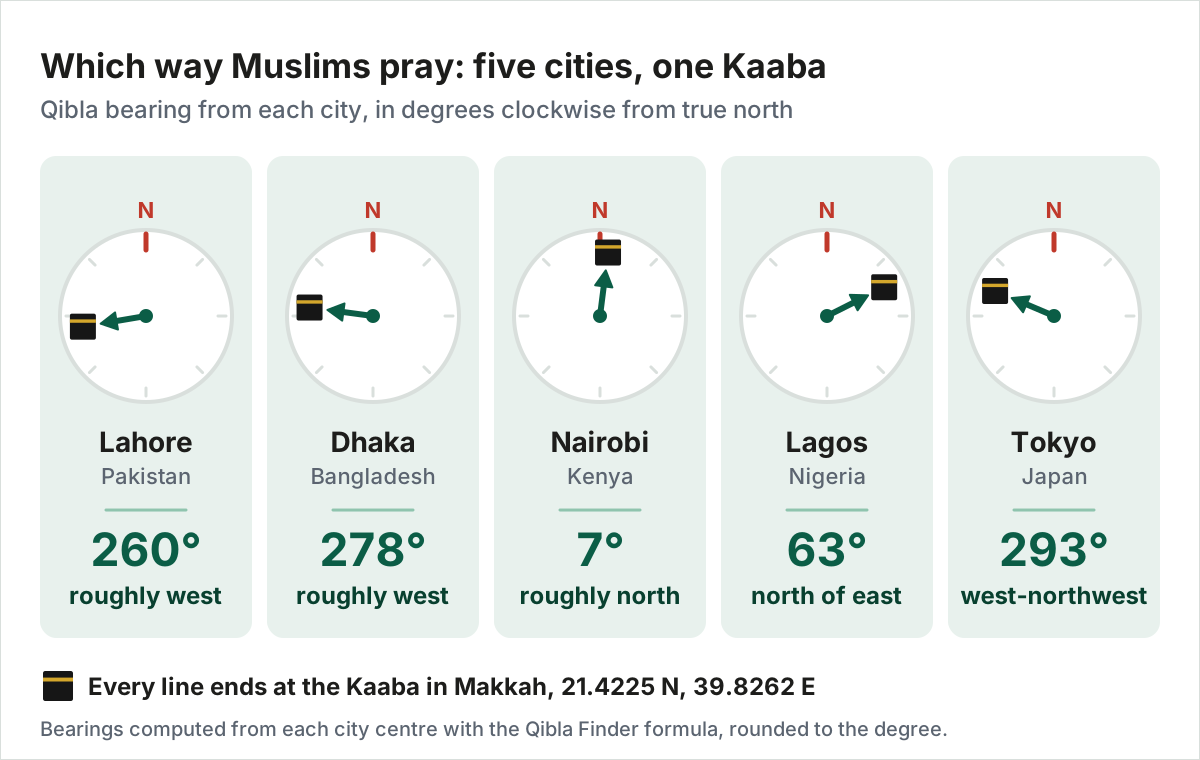
A flat map can fool you: from Tokyo it points a little south of west, while the shortest route over the globe leaves west-northwest. Each country's answer comes with the reason for that gap.
Do Muslims face east?
No, not as a rule. West Africa comes close, but even there the qibla is east-northeast, not due east. Quran 2:177 (Sahih International) opens with a line on exactly this: "Righteousness is not that you turn your faces toward the east or the west".
The words "face the east or the west" do appear in hadith, at Sahih al-Bukhari 144, and 394 has nearly the same line. The Prophet Muhammad (peace be upon him) gave them as a rule for relieving oneself in the open, not for prayer. Shaykh Safi ur-Rahman Mubarakpuri explains this line in his commentary on Bulugh al-Maram. In his reading the line was meant for the people of Madinah, whose qibla falls to the south. There, east or west meant standing side-on to the qibla.
Prayer directions in other faiths
Other faiths have their own directions, and some of them do face east. Eastward prayer dates from the early Church, and Oriental Orthodox churches keep it. Jews pray toward Jerusalem, and in many Jewish homes west of Israel a plaque called a Mizrah, Hebrew for "East", hangs on the eastern wall. The Baha'i Faith faces a point it calls the Qiblih.
When else do Muslims face the qibla?
Muslims turn to the qibla well beyond the five daily prayers. The table covers du'a, Hajj, slaughter and burial, and its last row shows two acts that turn away from it.
| Moment | What is done |
|---|---|
| Obligatory prayer | Make wudu (the washing before prayer), face the qibla, then say the takbir (Allahu akbar) |
| Voluntary prayer on a mount | Jabir reports, in Sahih al-Bukhari 400, that the Prophet prayed wherever his mount turned, then got down to face the qibla for obligatory prayer |
| Du'a | The recommended direction |
| Entering ihram (the pilgrim's sacred state) | Face the qibla |
| After the middle jamrah, a stone-throwing pillar on Hajj | Face the qibla |
| Slaughter | The animal is turned toward it |
| Burial | The body is aligned with it |
| Relieving oneself or spitting | Keep away from that direction |
The qibla also marks who belongs to the community, as the Prophet said in Sahih al-Bukhari 391:
"Whoever prays like us and faces our Qibla and eats our slaughtered animals is a Muslim ..."
Two practical questions come next: the margin scholars allow on the line, and a prayer that turned out to face the wrong way.
What is a qibla compass?
A qibla compass is a modified compass whose needle finds magnetic north, with a second pointer or marks for named cities to show the qibla. Wikipedia's qibla compass article credits the earliest known description to al-Ashraf Umar II (died 1296), a Rasulid sultan of Yemen. He did not claim to be the first. Ornate versions date from at least the 18th century.
The same object is also called a qibla indicator or a qiblanuma (qibla numa), where numa comes from the Persian namudan, "to show". A phone app is a different tool, and the arrow on your phone has its own checks.
What is qibla hour?
Qibla hour is the time when, seen from a given city, the sun stands on the line to Makkah. You may meet the term on the Turkiye Calendar, which has a section with that name. Anyone in that city who faces the sun then is facing the qibla, and the sun method shows how to use it.
FAQ
What is qibla called in English?
English kept the Arabic word, so qibla is also the English name, sometimes spelled qiblah or kiblah. If you need a plain English phrase for a colleague or a school essay, "direction of prayer" says the same thing.
Is the qibla in Makkah?
Yes. The line from any country ends at the Kaaba, the building inside Makkah's Grand Mosque, at 21.4225 N, 39.8262 E. For the city, the building and its distance from you, read where the Kaaba stands.
What does kiblat mean?
Kiblat is the Malay and Indonesian form of qibla, and in prayer it names the same direction. Indonesian took the word from Malay and also uses it for direction in general, so an Indonesian sentence may carry no religious sense at all.
Is facing the qibla required for every prayer?
Not every prayer. Ibn 'Uthaymeen, in IslamQA answer 65853, makes it a condition of valid prayer. He names three exceptions: a sick person who cannot turn, intense fear, and voluntary prayer while travelling. That last case raises the question of prayer on a plane or train. A local imam can apply this to your situation.
Conclusion
If the word sent you here from the Quran, read 2:142 to 2:150 in one sitting and use the verse table as your map. If a prayer is due and you have no device, a mihrab, the stars or a local Muslim can give you the line.