Praying in wrong qibla direction by mistake, after a real effort to find it, leaves past prayers valid for most of the scholars cited below. The stronger Shafi'i opinion, and Ibn Qudamah for someone in a town, ask you to repeat them. What you did before praying decides which answer fits you. Start by taking the qibla number for your city, so the next prayer is right.
Praying in wrong qibla direction, school by school
Most of the scholars in the table below keep a prayer valid when you tried to find the qibla and still got it wrong. Their answers differ on where you prayed and how certain the mistake is.
Ibn Qudamah's al-Mughni, quoted in IslamQA answer 43504, credits the no-repeat view to Malik, Abu Hanifah, and one of al-Shafi'i's two views.
| School or scholar | Prayers made after an effort, later found wrong |
|---|---|
| Hanafi, Maulana Irfan Ali of Darul Ifta Birmingham, approved by Mufti Mohammed Tosir Miah | Valid; using a compass counts as the effort |
| Hanafi, Mufti Ebrahim Salejee of MuftiOnline | Repeat, when a reliable check shows a qibla app was 90 off |
| Maliki, as Ibn Qudamah reports | Valid |
| Shafi'i, stronger opinion, as al-Nawawi gives it | Repeat, even after the prayer's time has ended |
| Shafi'i, second opinion, as Ibn Qudamah reports | Valid |
| Hanbali, Ibn Qudamah's general rule | Valid |
| Hanbali, Ibn Qudamah inside a town | Repeat, even if you asked someone |
| Hanbali, Ibn 'Uthaymeen | Valid in a town or on a trip, if you tried |
Ibn Qudamah's town rule rests on mihrabs and local people who know the line. On the Shafi'i side, Darul Iftaa Jordan told a woman who asked hospital nurses to repeat her prayers, since they only thought they knew.
Ibn 'Abd al-Barr, in al-Tamhid (10/426) as quoted in IslamQA 483121, reports agreement that a prayer made with no effort at all is repeated.
Which verse covers praying the wrong way?
Islamweb fatwa 81430 cites Quran 2:115 for an honest mistake, through the dark night report below. The verse opens (Saheeh International):
"And to Allah belongs the east and the west."
It goes on: whichever way a person turns, the Face of Allah is there. In Jami at-Tirmidhi 345, 'Amir ibn Rabi'ah says that on a very dark night on a trip, each Companion prayed his own way. In the morning they told the Prophet Muhammad (peace be upon him), and the verse came down.
At-Tirmidhi says the chain is not strong, as its narrator Ash'ath al-Samman was judged weak. Al-Albani graded it hasan (good). At-Tirmidhi adds that most scholars hold a prayer made the wrong way under clouds valid, naming Sufyan al-Thawri, Ibn al-Mubarak, Ahmad and Ishaq.
IslamQA answer 42574 adds Quran 64:16, "So fear Allah as much as you are able" (Saheeh International). Trying your best, it says, is what is required. Why the Kaaba is the direction at all comes from Quran 2:144 and the meaning of qibla.
What counts as a real effort
A real effort, in the answers above, means a method used with care before praying. IslamQA answer 42574 accepts even a neighbour's word if the neighbour takes prayer seriously.
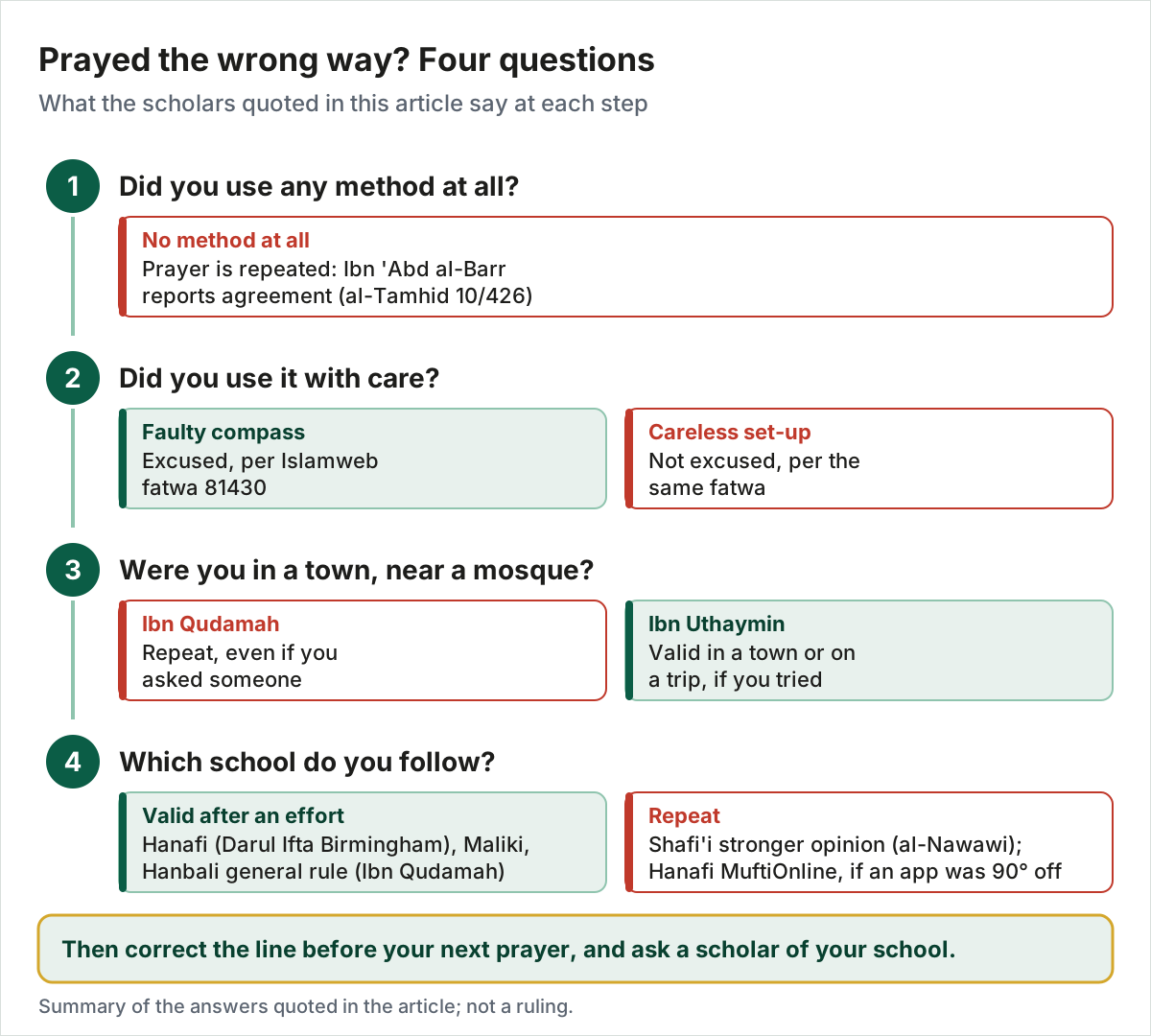
Four questions decide which row applies to you:
- Did you use any method at all? If not, Ibn 'Abd al-Barr's report applies.
- Did you use it with care? Islamweb fatwa 81430 excuses a faulty compass, but not carelessness in setting it up.
- Were you in a town, near a mosque? There Ibn Qudamah and Ibn 'Uthaymeen differ.
- Which school do you follow? The Shafi'i and Hanafi rows do not match.
IslamQA has answered the new-flat case. A reader prayed the opposite way for over a month, assuming the flat faced like his old one. IslamQA answer 483121 says ignoring a phone compass you knew about means repeating. If it never crossed your mind, it hopes there is no blame, yet calls making up the prayers the cautious choice.
With no phone or mosque, follow the order of signs, from mihrab to stars. If a phone misled you, test its arrow against your number.
If you notice the mistake during the prayer
Ustadh Salman Younas of SeekersGuidance, approved by Shaykh Faraz Rabbani, gives the Hanafi answer from al-Mawsili's al-Ikhtiyar. Turn and finish, he says, but only if you were unsure and had asked someone or used your own judgment first. Otherwise you start again. Darul Iftaa Jordan, quoting al-Nawawi, gives the Shafi'i rule: the prayer is repeated.
For later prayers, Shaykh Ibn Baz (Fatawa 10/421, quoted in IslamQA 42574) says to follow your newer estimate. The Companions also turned mid-prayer when the qibla changed.
When a mosque or family line was off
Two answers kept the past prayers and asked for re-marked rows; one left it to local scholars.
| Case | How far off | What the answer said |
|---|---|---|
| Musalla whose line about 7 people showed, an architect and an engineer among them | 32 | Darul Iftaa Azaadville (South Africa), approved by Mufti Muhammed Saeed Motara: past prayers valid, inside its 45 limit each side; re-mark the rows; Shafi'i members should ask a Shafi'i fatwa office |
| Village mosque checked by the awqaf (religious affairs office) | 17 | IslamQA answer 91405: past prayers valid; correct the rows and do not turn away from the qibla on purpose |
| Masjid set due east (90) for ten years, true line 66.52 | 23.48 | Darul Uloom Deoband: local ulama should decide, using Ahsan al-Fatawa volume 2 |
Azaadville's musalla found its error on a day the sun stands over the Kaaba. Deoband's masjid was set to a plain compass point, a trap that also explains why North American lines run northeast. Published limits for each gap are on how exact the qibla must be. Older mosques can follow historic lines that differ from your number.
What to do when the line was wrong
Correct the direction before your next prayer, as Ibn Baz advises above, then settle the past prayers with your own school's answer.
- Measure the gap. Note how many degrees off you were, and how you found the old line.
- Find your row in the two tables above. If your school says repeat, the order is in the FAQ.
Can your feet or bed face the qibla?
Two of the four answers below allow it, while Darul Uloom Deoband (Hanafi) and Shaykh Amjad Rasheed (Shafi'i) call it disliked.
| Scholar or body | On stretching your feet toward the qibla |
|---|---|
| Darul Uloom Deoband, Hanafi | Disliked when done on purpose, asleep or awake, by analogy with the toilet hadith |
| Shaykh Amjad Rasheed, Shafi'i, following Ibn Hajar | Offensive, not unlawful |
| Standing Committee, quoted in IslamQA answer 108273 | Nothing wrong with it, in a mosque or elsewhere |
| Darul Ifta Birmingham, Alimah Shireen Mangera-Badat | Permissible, since the primary sources hold no clear ban; better not to point them on purpose, out of respect |
In Shaykh Amjad Rasheed's answer, Ibn Hajar first thought it might be unlawful, then judged the Kaaba unlike a copy of the Quran. For a bed, Deoband's answer means setting it so your legs do not stretch toward the qibla.
How to face the qibla while sleeping
In Sahih al-Bukhari 247, the Prophet told al-Bara' ibn 'Azib to lie on his right side at bedtime. Some jurists add facing the qibla, says Islamweb fatwa 82233, which knows no hadith or Companion report on the direction of head or feet.
If you lie on your right side facing the qibla, your head points 90 degrees clockwise from the qibla. Your feet point 90 degrees the other way, across the qibla line. Bed directions for four cities:
| City | Qibla | Head of the bed toward | Foot of the bed toward |
|---|---|---|---|
| Blackburn, UK | 118 (east-southeast) | 208 (south-southwest) | 28 (north-northeast) |
| Accra, Ghana | 64 (east-northeast) | 154 (south-southeast) | 334 (north-northwest) |
| Doha, Qatar | 253 (west-southwest) | 343 (north-northwest) | 163 (south-southeast) |
| Chattogram, Bangladesh | 279 (west) | 9 (north) | 189 (south) |
Elsewhere, add 90 to your qibla number for the head and subtract 90 for the feet. With no compass, the sun's daily qibla time is another way to find the line.
Can a toilet face the qibla?
IslamQA answer 69808 reports that most jurists, Malik, al-Shafi'i and Ahmad among them, allow it inside a building. Abu Hanifah and Ibn Taymiyyah, it says, held it forbidden everywhere. In the open, Abu Ayyub's hadith in Sahih al-Bukhari 144 forbids facing the qibla or turning your back to it.
The building exception rests on Ibn 'Umar seeing the Prophet in Hafsah's house with his back to the Kaaba.
The Standing Committee (Fatawa al-Lajnah 5/97), quoted in the same answer, advises changing toilets still on the plans, and finds no sin if they cannot be changed.
On the Hanafi site Askimam, Mawlana Saanwal ibn Muhammad, checked by Mufti Ebrahim Desai, calls facing the exact qibla prohibitively disliked even indoors: adjust how you sit. He says to avoid the wider direction too, which he counts as 45 degrees either side. In Blackburn (qibla 118), that leaves facing between 163 and 253, or between 343 and 73 through north.
FAQ
Should I face the qibla when making dua?
Islamweb fatwa 88283 calls it recommended, not required: you are rewarded for facing the qibla in a supplication, and commit no sin if you do not. In Sahih al-Bukhari 1012, the Prophet faced the qibla when he asked Allah for rain.
Can you spit in the direction of the qibla?
Abu Dawud places it in his chapter "Spitting In A Masjid Is Disliked". In Sunan Abu Dawud 481, graded hasan by al-Albani, a man spat toward the qibla while leading a prayer. The Prophet then said the man should no longer lead those people in prayer.
Do I make up repeated prayers in order?
IslamQA answer 483121 says yes: make them up straight away, in their proper order, to the best of your ability. It quotes the Permanent Committee for Academic Research and Ifta on missed prayers: Fajr, then Dhuhr, then Asr.
Is my prayer valid if I guessed right?
Two answers say yes. Ibn 'Uthaymeen, in a passage quoted in IslamQA 483121, says no repeat is needed if you happened to face the right way. Shaykh Sohail Hanif, a SunniPath Academy teacher answering on Qibla.com, says the same once you can verify the direction you faced was correct.
Can two people with different qibla apps pray together?
IslamicPortal's answer by Shaykh Yusuf Shabbir, approved by two muftis, says not as a group if each thinks the other is wrong. Each traveller then prays alone in his own direction. They join only if another sign convinces one of them.
Conclusion
Your next prayer is the one you control, so put a taped qibla line in the room where you pray before it is due. For the months behind you, write down the method you used back then, because most answers on this page turn on it. Take that note to a scholar who follows your school.