If you are asking "how to find qibla direction in my room", the answer is one subtraction and a tape measure. Take the number the finder gives for your location, subtract the reading of the wall you face, and mark the result on the floor. In a Birmingham room with a wall reading 90, the qibla sits 27.9 degrees to your right.
How to find qibla direction in my room
Work from a wall, not from the arrow on your phone. A wall stays still, and once you know its angle the compass can go back in your pocket. You need a phone or needle compass, a tape measure and a strip of masking tape. No protractor is involved.
Step 1: Get your qibla number
Use the figure for your exact spot, written to one decimal place. Let the finder use your location, or paste your coordinates. The finder's main figure is a true-north number. A needle compass needs the magnetic number from the same result instead. Anyone just learning the practice can read what the qibla means in Islam first.
Step 2: Read one wall
Stand facing the wall and hold the phone flat at waist height, with its top edge pressed flat along the wall. That squares the phone to the wall, and the figure on screen is your wall reading. A needle compass goes flat on your palm while you stand square to the wall. Apple's Compass guide says the app shows the direction the iPhone points in and asks you to keep it flat.
A phone may read true north or magnetic north, and your qibla number has to match it. In Johannesburg, mixing the two moves your line about 21 degrees. Before you read, set the right north and steady the compass on your phone.
Read the same wall from three spots along it before you lay any tape, and keep the phone flat each time. If the three figures differ, move away from radiators, fridges and steel furniture and read again. A false reading caused by nearby metal has a name, magnetic deviation. Once the readings agree, use that figure.
Step 3: Work out the turn
Subtract the wall reading from the qibla number. A plus result means turn right, and a minus result means turn left. Pick the wall that gives the smaller answer, and move to the next wall if you get more than 45.
One trap catches rooms near north. If the result is below minus 180, add 360. A Johannesburg wall reading 350 gives 14.6 minus 350, which is minus 335.4. Adding 360 turns that into 24.6 to the right. If the result is above plus 180, subtract 360.
Step 4: Measure the angle on the floor
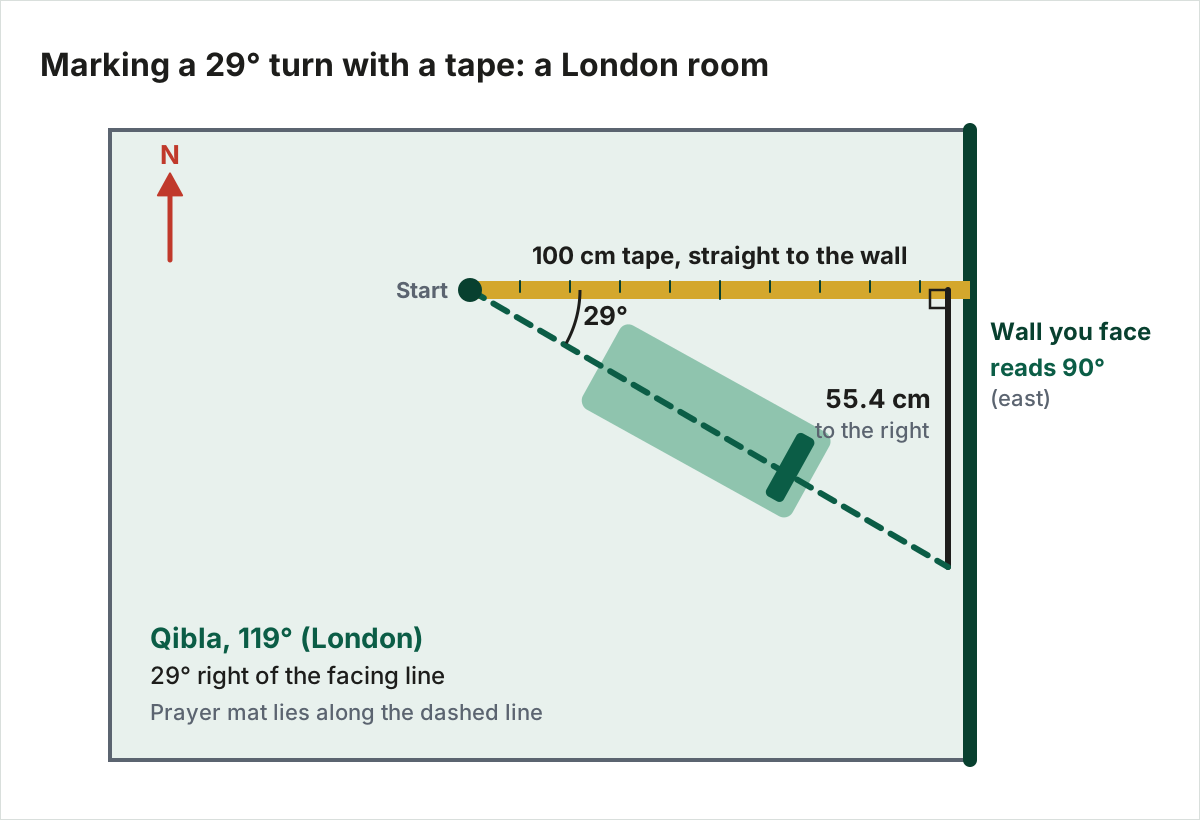
Lay the tape 100 cm straight toward the wall, at a right angle to it, so that it ends at the foot of the wall. To check the right angle, mark 30 cm along the wall from the end of the tape, and 40 cm back along the tape. Those two marks should sit 50 cm apart. From the end of the tape, measure sideways, parallel to the wall, by the figure in this table. Go right for a plus turn and left for a minus turn. The line from the start of the tape to your sideways mark is the qibla.
| Turn (degrees) | Sideways after 100 cm (cm) |
|---|---|
| 5 | 8.7 |
| 10 | 17.6 |
| 15 | 26.8 |
| 20 | 36.4 |
| 25 | 46.6 |
| 30 | 57.7 |
| 35 | 70.0 |
| 40 | 83.9 |
| 45 | 100.0 |
Each figure is 100 times the tangent of the turn, so a phone calculator gives you the exact value between rows. Short of floor? Use 50 cm and halve the figure. With more space, use 200 cm and double it, because a longer line is easier to continue across the room. On a 100 cm tape, a slip of 1 cm in the sideways measure moves the line by just over half a degree at most.
The sketch shows a London room with a wall reading 90. London's qibla number is 119, so the turn is 29 to the right and the sideways measure is 55.4 cm.
Step 5: Tape it and write it down
Press masking tape along the line, or stick one small piece at each end if the floor is on show. Then write the qibla number and the wall reading on a note inside a cupboard door. A guest can then repeat the work.
Marking a direction to check it later has an early precedent. The hadith of Jabir, narrated by ad-Daraqutni, al-Hakim and al-Bayhaqi, tells of a companion on a cloudy march who marked the way he faced. Al-Albani classed it sound because of corroborating reports (Irwa al-Ghalil 291), as quoted in IslamQA answer 148900.
Qibla direction wall examples
The same subtraction works on any wall, and these four sample rooms show the sum and the tape mark for uneven readings.
| City | Qibla number | Wall reads | Sum | Turn | Tape, after 100 cm |
|---|---|---|---|---|---|
| Birmingham | 117.9 | 104 | 117.9 - 104 = 13.9 | 13.9 right | 24.7 cm right |
| Dubai | 258.8 | 265 | 258.8 - 265 = -6.2 | 6.2 left | 10.9 cm left |
| Delhi | 266.6 | 281 | 266.6 - 281 = -14.4 | 14.4 left | 25.7 cm left |
| Johannesburg | 14.6 | 350 | 14.6 - 350 + 360 = 24.6 | 24.6 right | 45.8 cm right |
How do I find qibla in my house?
Use one qibla number for every room, then read one wall per room. Walking 100 metres in any direction across Birmingham changes the number by about 0.002 degrees at most, and 10 km by about 0.18. An extension or a converted garage may sit at a different angle, which is why the wall gets read again.
Close to Makkah (Mecca) the number moves much faster, by more than 8 degrees over 10 km in the worst direction from Jeddah. There, give the finder your own coordinates rather than the city name. Even in Jeddah, 100 metres changes it by less than a tenth of a degree, so a house still needs only one number.
Check your qibla line without a sensor
Choose a check that uses no sensor. Ask a neighbour who prays, or compare your line with the way a nearby mosque sits on your street. In a Muslim country, Ibn Baz names two ways to work out the qibla: asking someone, or "looking at the mosques" (quoted in IslamQA answer 148900). An older building may follow a line drawn long before modern maps, so treat a small gap as normal. Outdoors, use the shadow on the days the sun passes straight above the Kaaba. With no working phone at all, try the star and local methods that need no compass.
Mistakes that shift a qibla line at home
Read the wall yourself in every new room, because nearly every slip below starts with an assumption.
- Assuming a new home matches the old one. The walls sit at a new angle, so read them on your first day. If you learn later that you were off, see what happens to prayers already made.
- Treating a wall as due east or west. A building usually follows its plot and street, not the compass, so read the wall.
- Drawing the line on a flat map. A ruler gives the wrong number from most cities, as the North America case shows. Use the number, not the drawing.
- Trusting a hotel sticker unread. The wall routine works in a guest room as well, and a hotel sign or sticker is only a hint until it agrees with your own reading.
Laying out a prayer room or corner
Lay every mat along the taped line, even at an angle to the walls. To add a second mat, measure the same gap from the line at both ends of the first mat, and mark a parallel line there.
Families often want to square the mats to the nearest wall to save floor space. That choice turns on how far from the line scholars allow you to stand. Read what they say about your turn before you decide.
FAQ
Where is qibla direction in my room?
No wall or corner is fixed for everyone, because the answer depends on your city and how the room sits. In Dubai, with a wall reading 270, face that wall, go 100 cm toward it, then 19.8 cm left. The line to that mark is the qibla.
Should my prayer mat point at a corner?
Only if your taped line runs there. A corner lines up with the qibla only when the walls and the number agree, and most rooms do not. In Birmingham, if the walls face the four compass points, the qibla at 117.9 is about 17 degrees short of due south-east. So even the corner of a square room misses it.
What is the prayer direction as per Vastu?
Vastu is a Hindu tradition of building layout and does not set the direction of salah. Muslims pray toward the Kaaba wherever they live, so the direction comes from your location. In Delhi that number is 266.6 degrees, a little south of due west.
Is the qibla direction in my room right?
Look for agreement from something other than your phone. A nearby mosque within a few degrees of your line counts. A mosque can be built up to five degrees off its calculated line, says Wikipedia's Qibla article.
Can I mark the qibla without a tape measure?
Yes, count floor tiles if they are square and run square to the wall. Go 10 tiles straight toward the wall, then divide the sideways figure by 10 and go that many tiles across. A turn of 13.9 degrees needs 24.7 cm per 100, so 10 tiles out and about 2.5 across.
Conclusion
Once the tape is down, the compass has done its job, and the line stays good until you move home, because the qibla direction does not change over time for a place that stays put. The one check still worth doing is on a clear day in a month when your city has a daily qibla time, using the shadow at that moment.