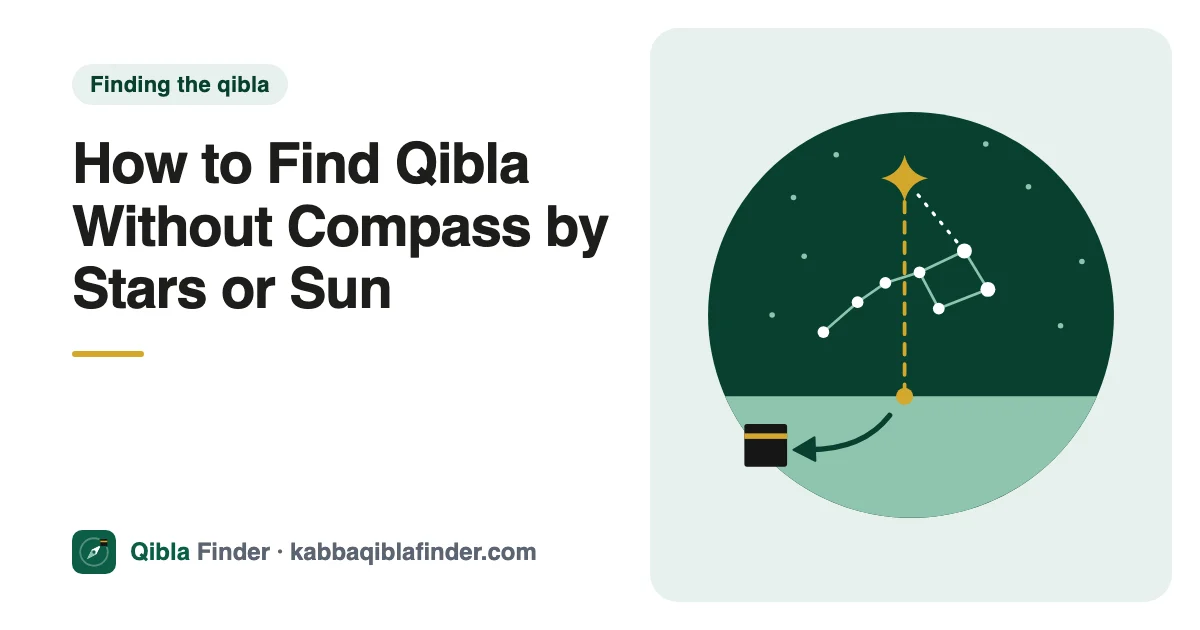
Knowing how to find qibla without compass comes down to two steps: get one fixed line, then turn from it by your number. The qibla finder gives that figure in degrees for your spot. A nearby mosque or Muslim shows you the line. At night, Polaris gives north and the Southern Cross gives south. In Lahore you turn 100 degrees left of north. In Sydney, about 98 right of south.
Pick the method that fits where you are
Use a mosque or a Muslim nearby if you can reach one, and the stars if you cannot.
| Where you are | What to use | When it lets you down |
|---|---|---|
| Near a mosque or Muslim neighbours | The mihrab, or a person's line | Nobody awake, or an old mosque on an older line |
| Clear night, north of 20 N | Polaris | Cloud or city glare |
| Clear night, south of the equator | Southern Cross | In the tropics, it shows mainly from April to June |
| Cloudy night, nobody to ask | Your own best judgement | You cannot test it until the sky clears |
| Daytime with sun | A stick and its shadow | Thick cloud |
| Phone with no compass sensor | Your number, then a star or a mosque line | You make the turn by hand |
| No mobile data | A number you wrote down earlier | You forgot to write it |
The star rows need that number, which points toward the Kaaba in Makkah (Mecca). The finder takes your location or a city name, so look it up and write it down while you have a connection.
Start with a mosque or a Muslim nearby
A mihrab, the prayer niche in a mosque wall, shows the direction Muslims face in prayer with no arithmetic. So does a neighbour who already prays there.
- Walk to the closest mosque or prayer room and stand square to the wall with the niche.
- Find a long, straight road that runs past both the mosque and your home.
- Note the angle between the qibla wall and that road.
- At home, stand beside the same road and keep the same angle.
No mosque close by? Ask a shopkeeper or neighbour who prays which way they face, and which road or building they line up with. Away from home, hotels and planes need their own checks.
A newer or surveyed mosque is the safer model. Al-Azhar in Cairo faces 127 degrees where modern calculation gives about 135, and the wall itself can follow an older line.
What order do scholars give?
Hanafi and Shafi'i sources both put a mosque or a person who knows ahead of your own guess. Mufti Muhammad I.V. Patel of Darul Iftaa Mahmudiyyah in Lusaka, Zambia, answered this exact case: a new place, at night, with no device.
His fatwa sets it out like this:
- Ask people who live in that town. You may follow a reliable local. If that person turns out to be wrong, the fatwa says "the Salaah performed in the incorrect direction will still be valid".
- Use the signs named in Radd al-Muhtar 1/433, a Hanafi text. These are mihrabs, the stars and asking someone who knows. While any of them is open to you, you do not fall back on a guess.
- Use the stars in open country. The same passage says a person who can read the stars, under a clear sky, may not guess there.
- Use your own best judgement (tahharri) last. With nobody to ask, you work out the direction as well as you can and pray that way.
The Shafi'i school, in Abu Ishaq al-Shirazi's Kitab al-Tanbih, reads much the same. Far from Makkah, follow the local mosque or a trustworthy person. If neither is possible, use your own reasoning (ijtihad). Prayers you already made are a separate matter, covered under learning later that you faced the wrong way.
How to find qibla without compass at night
Your latitude decides the star. Polaris stands about as high above the horizon as your latitude, so it sinks as you travel south and reaches the horizon at the equator. The Southern Cross shows from 20 N southward.
| Your latitude | Example cities | Polaris above the horizon | Southern Cross | Use |
|---|---|---|---|---|
| North of 20 N | Birmingham, Toronto, Lahore, Karachi, Dubai, Dhaka | 52, 44, 32, 25, 25 and 24 degrees | Out of view or very low | Polaris |
| Equator to 20 N | Lagos, Kuala Lumpur | 6 and 3 degrees | Low in the south, April to June | Either |
| Equator to about 34 S | Nairobi, Johannesburg | Below the horizon | Part of the year or part of the night | Southern Cross, or ask a local |
| About 34 S and further | Sydney on the edge | Below the horizon | Up all night | Southern Cross |
Haze and buildings can hide a star that sits this low, so in Lagos or Kuala Lumpur climb to a roof. The Quran also names the stars as a guide, in Surah An-Nahl 16:16 (Sahih International on quran.com):
"And landmarks. And by the stars they are [also] guided."
Finding north from Polaris
North of the equator, one straight line across the sky takes you to Polaris (the North Star).
- Find the Big Dipper, called the Plough in the UK. Look at the outer edge of its bowl, with Merak at the base and Dubhe at the rim. In Lahore, Karachi, Dubai or Dhaka the bowl can dip under the northern horizon. If it has, look again later in the night.
- Draw a line from Merak through Dubhe, the two stars called the Pointers. Carry it on past Dubhe for about five times the gap between them.
- Stop at the star you reach. Do not go by brightness, because Polaris is not the brightest star in the sky.
- Drop your eyes straight down to the horizon. That spot is true north, since Polaris sits under 1 degree from the point the whole sky turns around.
- Face the horizon spot and not the star, then make your turn.
Finding south from the Southern Cross
In the southern sky, the long bar of a small cross leads you to south.
- Find four bright stars in a small cross. Alpha and Beta Centauri, two bright stars close by, help you spot it.
- Take the long bar, from Gamma Crucis to Alpha Crucis at the foot, the brightest star of the cross. The cross tilts as the night goes on, so go by brightness and not by which star looks lowest. The short bar points well away from south.
- Carry that line past the foot by about 4.5 times the length of the bar. Well south of the equator, you land on an empty patch of sky.
- Drop straight down from that patch to the horizon. In Nairobi, Lagos or Kuala Lumpur the patch is at or below the horizon. There, wait until the cross stands upright, then follow the long bar down to where it meets the ground line. Face that spot, then use the "from south" column below.
Near the equator, outside April to June, ask a local, go to a mosque, or wait for the morning sun. By day, use the sun, and on two days a year shadows point straight away from the qibla, as the sun-over-Kaaba page explains.
Turn from north or south by your number
A number of 180 or less means a right turn from north, and a number over 180 means a left turn. In numbers:
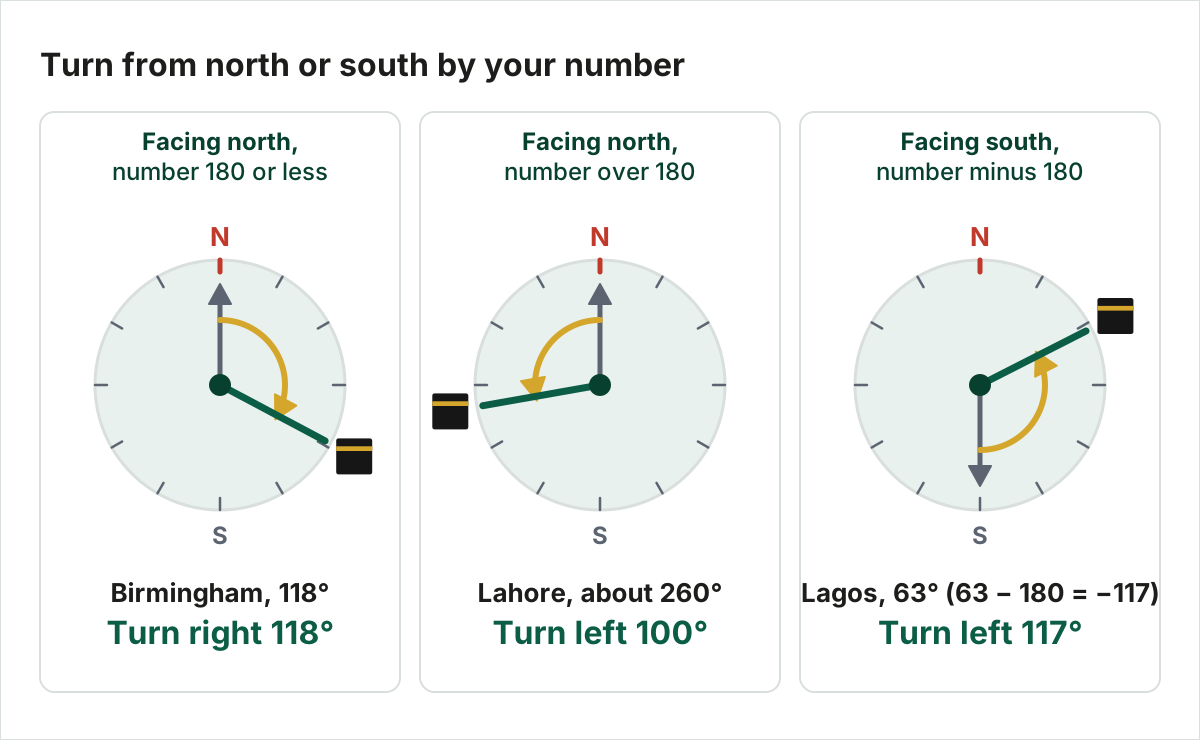
- Facing north, number 180 or less: turn right by the number. Nairobi is 7, so right 7.
- Facing north, number over 180: turn left by 360 minus the number. Lahore is about 260, so left 100. Turn right by mistake and you end up 160 degrees off the line.
- Facing south: take 180 from the number. A plus answer means turn right and a minus answer means turn left. Lagos is 63, so left 117.
Figures are rounded to the whole degree. For the last column, picture a clock lying flat with 12 toward north, and read where its hour hand would point.
| City | Turn from north | Turn from south | Hour hand on the flat clock |
|---|---|---|---|
| Lahore | Left 100 | Right 80 | Two-thirds of the way from 8 to 9 |
| Karachi | Left 92 | Right 88 | Just before 9 |
| Dhaka | Left 82 | Right 98 | A quarter of the way from 9 to 10 |
| Dubai | Left 101 | Right 79 | Just under two-thirds from 8 to 9 |
| Kuala Lumpur | Left about 68 | Right about 113 | Three-quarters from 9 to 10 |
| Nairobi | Right 7 | Turn around, then right 7 | A quarter of the way from 12 to 1 |
| Lagos | Right 63 | Left 117 | Just past 2 |
| Birmingham | Right 118 | Left 62 | Just before 4 |
| Toronto | Right 55 | Left 125 | Just before 2 |
| Sydney | Left about 83 | Right about 98 | A quarter of the way from 9 to 10 |
Is your town missing? Do not borrow the closest row. Near Makkah it can send you the wrong way. Jeddah, west of Makkah, needs a right turn from north, but its closest row, Dubai, is a left turn of 101. Look up your own town before you travel. Toronto's small turn surprises readers who expect to face east, and the path to Makkah from Canada really does start north-east.
Measure the turn with your arms and a clock
Your two arms give you 90 degrees and a clock face gives you the rest. Hold one arm straight ahead and the other straight out to the side: the gap is 90. Halfway between them is 45, and facing back the way you came is 180. Each hour on a clock is 30 degrees, so a third of an hour is 10 and a quarter is 7.5.
- Lahore, left 100 from north. Turn to your left arm (90), then go a third of an hour further (10).
- Sydney, right about 98 from south. Turn to your right arm (90), then add a quarter of an hour (7.5).
Arms and a clock get you close, though not to a surveyed line. Your next question may be what scholars say about a few degrees out.
If your phone has no compass or no data
A phone with no compass sensor can still help, because your number depends only on where you stand. With no signal, use the number you wrote down while you had one. Take it to a star or a mosque line and turn by hand. If a sensor is present but reads wrong, settle the phone's arrow first.
Before a trip, write two lines in a notebook. One holds your home number and its turn from north. The other holds the same for where you are going. Your number moves with you as you travel, so one town's turn will not serve the next.
FAQ
How to find qibla without compass at home?
Ask the nearest mosque or a Muslim neighbour which way they pray, then compare that line with a straight road that also passes your home. On a clear night, test the result from a balcony or roof against Polaris or the Southern Cross.
Which way do I pray on a cloudy night?
Thick cloud can hide both Polaris and the Southern Cross, so knock on a door and ask anyone nearby who prays. If nobody can be found, Darul Iftaa Mahmudiyyah allows you to use your own best judgement. Test that line once the sky clears.
How do I check the qibla without a compass?
Get the same line from two separate signs, such as Polaris at night and a mihrab the next day. If the two lines disagree, repeat both, and confirm that you started from the horizon point and made the turn in the correct direction.
How did Muslims find the qibla before compasses?
Early Muslims watched the sun, moon, stars and wind, a practice known as folk astronomy. In Syria, people used the rising point of the star Canopus (Suhayl). Methods based on a round Earth and mathematics came later.
Conclusion
Tracing a line to Polaris or the Southern Cross feels slow the first time, so practise on a clear evening before you need it. Once a line has passed a second check, make it permanent on your wall or floor and the sky becomes a backup at home. Keep the paper with your numbers in your bag for the next trip.